



Free Shipping on Orders $35+

Login
Amazon American Express Apple Pay Diners Club Discover Google Pay Mastercard PayPal Shop Pay Venmo Visa
Non-GMO
Supports Family Farms
Heirloom

Branscomb's Brilliant Ornamental Corn

Quick Facts:

  • Ornamental corn variety
  • Selected from Indigenous strain
  • Stunning multicolored kernels
  • Attractive fall-inspired colors
  • Use for decor, grinding, feed

View full description

Quantity: Packet (50 Seeds)

shipping estimated time of arrival Get it between -

We ship to all areas of North America including the United States, its territories and outlying islands, and Canada. International orders may incur an additional charge to cover the handling of customs paperwork. Returns are accepted within 30 days of receipt. Full warranty information can be found here.
Branscomb's Brilliant Ornamental Corn

More about Branscomb's Brilliant

Zea mays

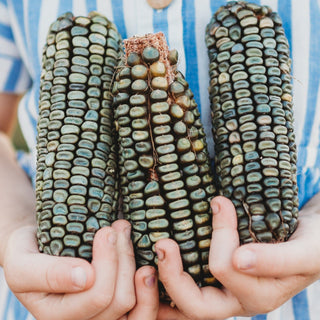
Branscomb’s Brilliant Ornamental Corn is a striking, multi-colored corn selected for beauty and abundance. The population traces back to seed assembled in the 1970s by Donald Branscomb of Clearlake, California, from corn purchased at a roadside market in Fresno. While the original USDA accession retains a legacy name, we offer this variety under a new name that preserves its documented history without perpetuating outdated terminology.

Plants averaged 7–8 feet tall and showed some natural variation, with roughly a quarter of the plants exhibiting deep purple stalks and others showing purple glumes. Tassels were large and productive, and yields were consistently good across the planting. Ears were well f... More

Less

Zea mays

Branscomb’s Brilliant Ornamental Corn is a striking, multi-colored corn selected for beauty and abundance. The population traces back to seed assembled in the 1970s by Donald Branscomb of Clearlake, California, from corn purchased at a roadside market in Fresno. While the original USDA accession retains a legacy name, we offer this variety under a new name that preserves its documented history without perpetuating outdated terminology.

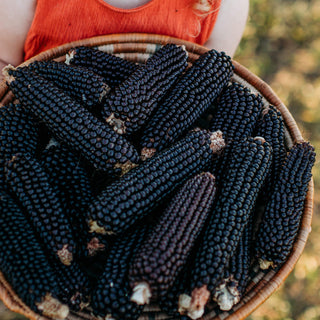
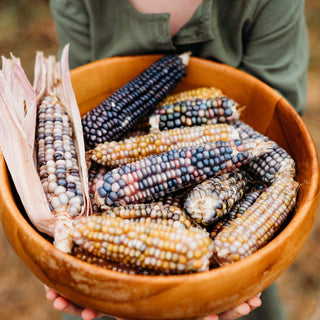
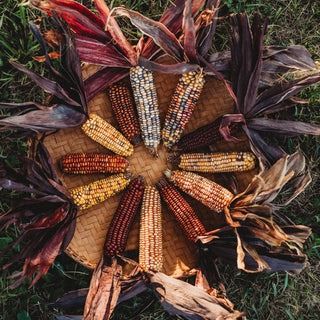
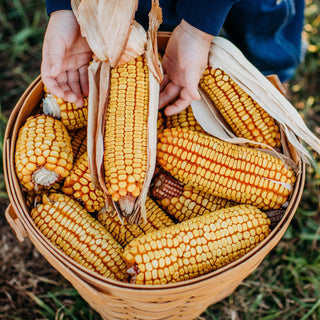
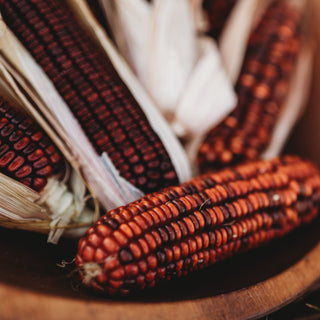
Plants averaged 7–8 feet tall and showed some natural variation, with roughly a quarter of the plants exhibiting deep purple stalks and others showing purple glumes. Tassels were large and productive, and yields were consistently good across the planting. Ears were well filled with a mix of glossy and lightly floury kernels in warm shades of black, red, orange, bronze, and occasional white—an especially rich and harmonious color range.

This variety makes a stunning fall decoration, with rich, autumn-inspired colors that hold well on the ear. Beyond ornamental use, the kernels are also well suited to grinding for cornmeal and grits, offering both visual appeal and practical value. When the season was over, our chickens made quick work of the leftovers, finding it just as satisfying as we did.  All-in-all a practical and beautiful ornamental corn variety.  Matures approximately 115 days after sowing.  Each packet contains a minimum of 50 seeds.

Seed stock generously provided by the National Genetic Resources Program. PI 708638

Zea mays

Branscomb’s Brilliant Ornamental Corn is a striking, multi-colored corn selected for beauty and abundance. The population traces back to seed assembled in the 1970s by Donald Branscomb of Clearlake, California, from corn purchased at a roadside market in Fresno. While the original USDA accession retains a legacy name, we offer this variety under a new name that preserves its documented history without perpetuating outdated terminology.

Plants averaged 7–8 fe... read more

read less

Zea mays

Branscomb’s Brilliant Ornamental Corn is a striking, multi-colored corn selected for beauty and abundance. The population traces back to seed assembled in the 1970s by Donald Branscomb of Clearlake, California, from corn purchased at a roadside market in Fresno. While the original USDA accession retains a legacy name, we offer this variety under a new name that preserves its documented history without perpetuating outdated terminology.

Plants averaged 7–8 feet tall and showed some natural variation, with roughly a quarter of the plants exhibiting deep purple stalks and others showing purple glumes. Tassels were large and productive, and yields were consistently good across the planting. Ears were well filled with a mix of glossy and lightly floury kernels in warm shades of black, red, orange, bronze, and occasional white—an especially rich and harmonious color range.

This variety makes a stunning fall decoration, with rich, autumn-inspired colors that hold well on the ear. Beyond ornamental use, the kernels are also well suited to grinding for cornmeal and grits, offering both visual appeal and practical value. When the season was over, our chickens made quick work of the leftovers, finding it just as satisfying as we did.  All-in-all a practical and beautiful ornamental corn variety.  Matures approximately 115 days after sowing.  Each packet contains a minimum of 50 seeds.

Seed stock generously provided by the National Genetic Resources Program. PI 708638

Glory of Enkhuizen

How to Grow Corn

Corn performs best in soil that is well-drained, but also able to hold onto some moisture, as corn tends to use quite a bit of water during its active growth phase.  Working in a healthy dose of well-composted manure in the fall will ensure that the rapidly growing plants receive adequate water and nutrition. 

After danger of frost has passed and soil temps have reached 55 degrees, sow seeds 9-12" apart, 1" deep, in rows 24-36" apart.  To maximize pollination use a paired row or square plot configuration.  Under ideal conditions, germination will occur in 7-10 days.

Not recommended

Insect Pests

Biological controls such as Bacillus thuringiensis can be effecting in controlling common corn pests like corn borer and earworm.  Aphids, Japanese beetles, and other hard-shelled insects can be controlled with a simple homemade insecticidal soap solution.

Diseases & Other Problems

Corn is susceptible to a number of plant diseases.  Consult your local extension office to learn which diseases are most prevalent in your region. Crop rotation, tillage, and removal of plant debris are all effective tools in managing common corn diseases.

Sweet corn is ready to harvest approximately 21 days after pollination. At peak, the kernel tips should be rounded and glossy. Shelling corn can be harvested once the husks have dried and the kernels have sufficiently hardened.  To test for maturity, pull back the husk and remove a kernel from the ear.  If the tip at the base of the kernel breaks off to reveal a brown "abscission" layer, the ears are ready to harvest.

CONSIDERATIONS:

To maintain genetic diversity, save seed from at least 50 to 100 plants.  If open-pollinated, plants should be isolated from other corn varieties by at least 1/4 mile.  Otherwise, hand-pollination can be performed.

HARVESTING SEED:

Wait until ears have reached full maturity and the kernels cannot be pierced by your fingernail. Peel back the husk and harvest the ear by pulling down and twisting. Place in a mesh bag or basket and allow to continue to dry for two weeks. Shell ears using a manual corn shelling tool or tightly grip a gloved hand around the ear and twist to separate the kernels from the cob. Winnow to remove any chaff and store in an airtight container until ready to use.

SEED LONGETIVITY:

Corn seeds will maintain 50% viability for three years when stored in a cool, dark place.

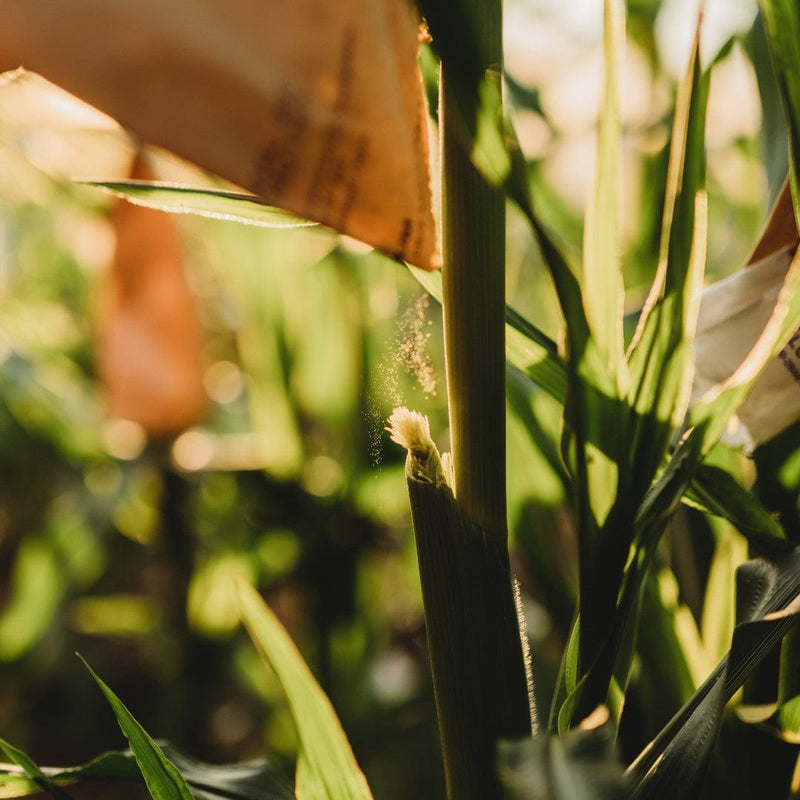
Hand pollinating corn

Search