We ship to the United States, its territories and outlying islands. Returns are accepted within 30 days of receipt. Full warranty information can be found here.






✓ Plant with Confidence—Guaranteed Through 2027
 Get it between -
Open-pollinated varieties, perfect for seed saving.
Safe seeds, free of neonics and other treatments.
It's simple. If you have a problem, we make it right.

Capsicum annuum
Golden Treasure is an open-pollinated variety of pepper that produces 6 to 9-inch-long peppers with glossy, golden skins and thick, sweet flesh. Sometimes reportedly known as Marconi Golden, this variety has somewhat of an elusive history. Our strain was given to us by our friends at Blue Note Gardens of Redfield, Iowa who acquired it some time ago from the Seed Savers Exchange. We haven't been able to confirm that Golden Treasure is in fact a golden selection of Marconi Red, but the two do share some similarities. What we do know is that Golden Treasure peppers are delicious, with an incredibly sweet flavor and very thin skins. Our 4-year-old and I (this is Becky writing) fought over these all sum... More
Capsicum annuum
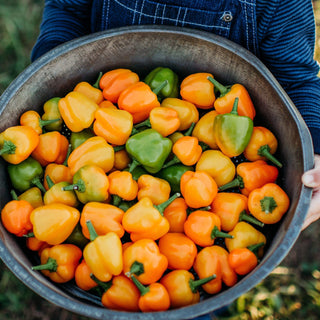
Golden Treasure is an open-pollinated variety of pepper that produces 6 to 9-inch-long peppers with glossy, golden skins and thick, sweet flesh. Sometimes reportedly known as Marconi Golden, this variety has somewhat of an elusive history. Our strain was given to us by our friends at Blue Note Gardens of Redfield, Iowa who acquired it some time ago from the Seed Savers Exchange. We haven't been able to confirm that Golden Treasure is in fact a golden selection of Marconi Red, but the two do share some similarities. What we do know is that Golden Treasure peppers are delicious, with an incredibly sweet flavor and very thin skins. Our 4-year-old and I (this is Becky writing) fought over these all summer long. Don't tell him that the competition was rigged—Mom wins either way. The plants were also incredibly productive. I don't think they'd have been able to stay upright had we not caged them. Golden Treasure matures approximately 80 days after transplant. Each packet contains a minimum of 25 seeds.
Capsicum annuum
Golden Treasure is an open-pollinated variety of pepper that produces 6 to 9-inch-long peppers with glossy, golden skins and thick, sweet flesh. Sometimes reportedly known as Marconi Golden, this variety has somewhat of an elusive history. Our strain was given to us by our friends at Blue Note Gardens of Redfield, Iowa who acquired it some time ago from the Seed Savers Exchange. We haven't been able to confirm that Golden Treasure is in fact a golden sele... read more
Capsicum annuum
Golden Treasure is an open-pollinated variety of pepper that produces 6 to 9-inch-long peppers with glossy, golden skins and thick, sweet flesh. Sometimes reportedly known as Marconi Golden, this variety has somewhat of an elusive history. Our strain was given to us by our friends at Blue Note Gardens of Redfield, Iowa who acquired it some time ago from the Seed Savers Exchange. We haven't been able to confirm that Golden Treasure is in fact a golden selection of Marconi Red, but the two do share some similarities. What we do know is that Golden Treasure peppers are delicious, with an incredibly sweet flavor and very thin skins. Our 4-year-old and I (this is Becky writing) fought over these all summer long. Don't tell him that the competition was rigged—Mom wins either way. The plants were also incredibly productive. I don't think they'd have been able to stay upright had we not caged them. Golden Treasure matures approximately 80 days after transplant. Each packet contains a minimum of 25 seeds.