We ship to the United States, its territories and outlying islands. Returns are accepted within 30 days of receipt. Full warranty information can be found here.






✓ Plant with Confidence—Guaranteed Through 2027
 Get it between -
Open-pollinated varieties, perfect for seed saving.
Safe seeds, free of neonics and other treatments.
It's simple. If you have a problem, we make it right.

Zea mays
Cocke’s Prolific is an heirloom variety of dent corn long prized for its ability to produce multiple, well-filled ears on a single stalk—a trait that made it especially valuable to Southern farmers seeking dependable yields under variable conditions. The variety was developed by John Hartwell Cocke of Fluvanna County, Virginia, a noted agricultural reformer and close friend of Thomas Jefferson. By the mid-19th century, Cocke’s Prolific had gained wide recognition throughout the South for its productivity and resilience.
Traditionally grown as a feed and milling corn, Cocke’s Prolific produces multiple, uniform ears packed with dense dent kernels that dry down well on the stalk. It has been used for live... More
Zea mays
Cocke’s Prolific is an heirloom variety of dent corn long prized for its ability to produce multiple, well-filled ears on a single stalk—a trait that made it especially valuable to Southern farmers seeking dependable yields under variable conditions. The variety was developed by John Hartwell Cocke of Fluvanna County, Virginia, a noted agricultural reformer and close friend of Thomas Jefferson. By the mid-19th century, Cocke’s Prolific had gained wide recognition throughout the South for its productivity and resilience.
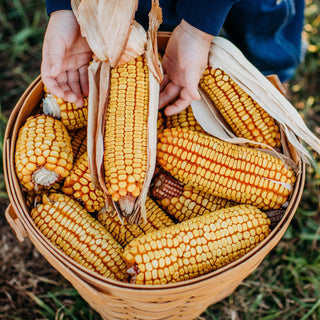
Traditionally grown as a feed and milling corn, Cocke’s Prolific produces multiple, uniform ears packed with dense dent kernels that dry down well on the stalk. It has been used for livestock feed, cornmeal, grits and general farm use—an all-purpose workhorse well suited to self-reliant homesteads. Like many historic farm varieties, it was eventually thought to be extinct, surviving only because it was preserved on the Cocke family farm.
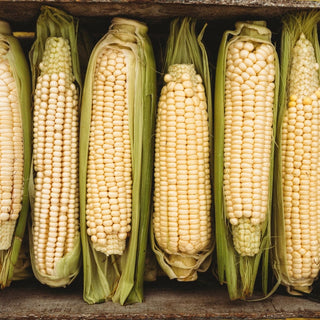
In our 2025 trials, Cocke’s Prolific proved its historic reputation well deserved. In a season marked by early soggy soils followed by extended drought, it remained productive and sturdy when many other corns struggled. The ears were shorter than we expected, however this might be explained by our late planting date (June 15th). Still, in what was otherwise a lackluster year for corn, Cocke’s Prolific stood apart—an outlier in the field, just as it was generations ago. Matures approximately 115 days after sowing. Each packet contains a minimum of 50 seeds.
Zea mays
Cocke’s Prolific is an heirloom variety of dent corn long prized for its ability to produce multiple, well-filled ears on a single stalk—a trait that made it especially valuable to Southern farmers seeking dependable yields under variable conditions. The variety was developed by John Hartwell Cocke of Fluvanna County, Virginia, a noted agricultural reformer and close friend of Thomas Jefferson. By the mid-19th century, Cocke’s Prolific had gained wide recognition t... read more
Zea mays
Cocke’s Prolific is an heirloom variety of dent corn long prized for its ability to produce multiple, well-filled ears on a single stalk—a trait that made it especially valuable to Southern farmers seeking dependable yields under variable conditions. The variety was developed by John Hartwell Cocke of Fluvanna County, Virginia, a noted agricultural reformer and close friend of Thomas Jefferson. By the mid-19th century, Cocke’s Prolific had gained wide recognition throughout the South for its productivity and resilience.
Traditionally grown as a feed and milling corn, Cocke’s Prolific produces multiple, uniform ears packed with dense dent kernels that dry down well on the stalk. It has been used for livestock feed, cornmeal, grits and general farm use—an all-purpose workhorse well suited to self-reliant homesteads. Like many historic farm varieties, it was eventually thought to be extinct, surviving only because it was preserved on the Cocke family farm.
In our 2025 trials, Cocke’s Prolific proved its historic reputation well deserved. In a season marked by early soggy soils followed by extended drought, it remained productive and sturdy when many other corns struggled. The ears were shorter than we expected, however this might be explained by our late planting date (June 15th). Still, in what was otherwise a lackluster year for corn, Cocke’s Prolific stood apart—an outlier in the field, just as it was generations ago. Matures approximately 115 days after sowing. Each packet contains a minimum of 50 seeds.