

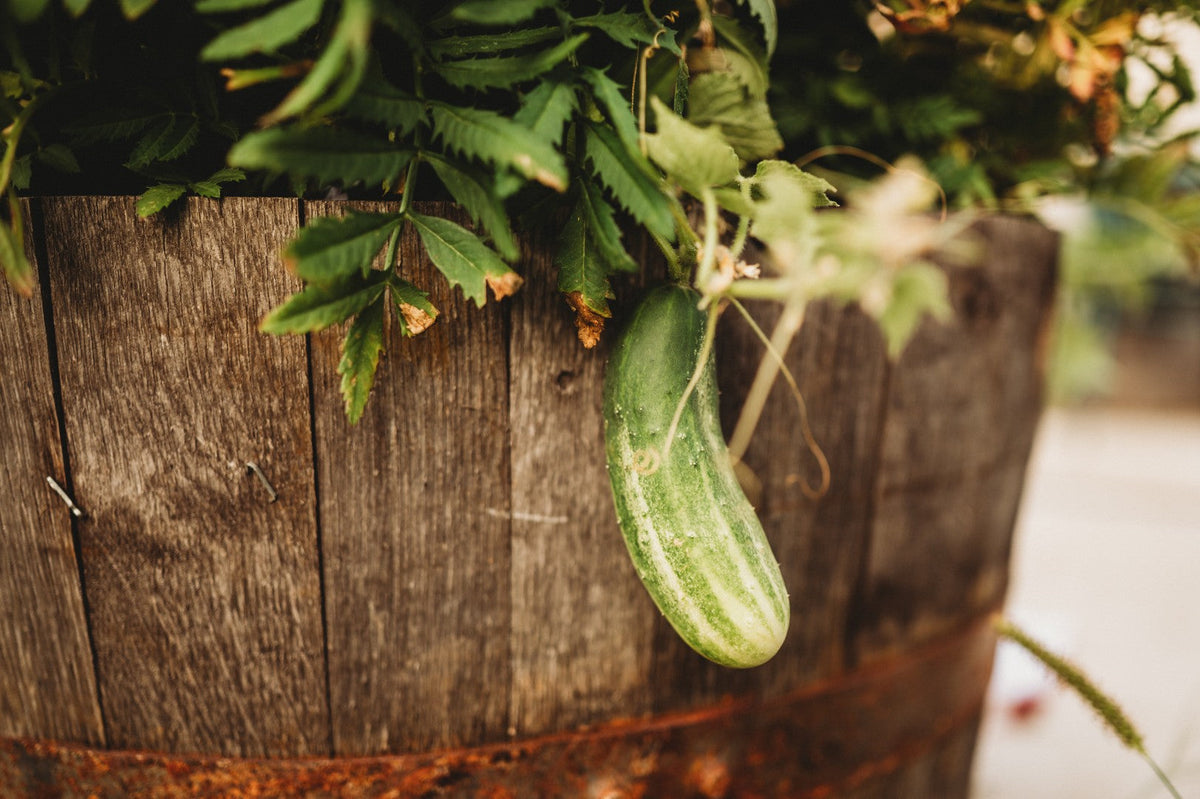
Growing cucumbers in containers is something that seems like it should be easy. I mean—come on—they’re pickles. They belong in barrels.
But alas, the truth is that growing cucumbers this way can actually be a little tricky. In fact, this challenge—growing cucumbers anywhere but in open soil—is one that has vexed gardeners for generations. Take this example:
In the spring of 1811, a recently retired Thomas Jefferson set out on one of his many gardening experiments:
“forward cucumbers [planted] in the hogshead by the middle gate of the garden. Long Green cucumbers… in the same hogshead”
—Thomas Jefferson’s Garden Book, April 13, 1811
A quick clarification for those of you who don’t have wooden teeth: a hogshead is essentially a whiskey barrel.
Jefferson tried again the following year, making additional plantings on February 22 and March 8—early by any standard, even by Jefferson’s. And yet, despite his meticulous habit of recording the sowing and harvest of nearly every crop grown at Monticello, no harvest entry for those cucumbers can be found. The silence suggests the experiment, at least that time, proved fruitless.

Growing cucumbers in containers is something that has challenged generations of Americans—even presidents! But with a little extra effort, we can make our container grown cucumbers a success.
In the more than 200 years since Jefferson’s attempt, countless gardeners have wrestled with the same challenge with plenty of frustration along the way (myself included). Cucumbers can be demanding plants, and containers leave little room for error.
But it is possible—and when done right, it can be remarkably productive.
In this article, we’ll walk through exactly how to grow cucumbers successfully in containers, detail by detail, so that your garden experiment ends not in silence—but in success (and pickles).
Before We Begin: Setting Expectations
There are really only two reasons to grow cucumbers in barrels or containers. The first is practical—you simply don’t have the space to grow them on the ground. The second is less so: curiosity, tomfoolery, stubbornness. Doing it just to see if you can. No judgement here—my motivations fall squarely in that second category.
It’s worth saying plainly: cucumbers will always perform better when grown in the ground with room to sprawl. In open soil, they’re able to put down larger root systems, including secondary roots, that help regulate water, nutrient uptake, and overall vigor—advantages that containers simply can’t replicate. Growing them in pots is a compromise by definition. But it’s a compromise that can still be surprisingly productive, provided you understand what you’re giving up and adjust your approach accordingly.

Sometimes you've gotta do what you gotta do—and homemade pickles are worth every bit of that effort.
The Rules—and Why They Matter
By now, we all understand the tradeoff: growing cucumbers in containers is a challenge, but a worthwhile one. The rules below are designed to acknowledge the limitations of container-grown cucumbers—and to compensate for them deliberately. Follow these guidelines, and you’ll be giving your plants the best possible chance to thrive, which, as gardeners, is ultimately all we can ask of ourselves.

Important considerations, like choosing the right variety, the right soil, and the right container size are crucial to getting your cucumbers off on the right track.
Rule #1: Choose the Right Variety
If there’s one place you can’t afford to get this wrong, it’s here. Choosing the right variety is the single most important factor when growing cucumbers in pots. You can use the perfect soil, water diligently, prune carefully—and if you start with the wrong cucumber, you’ll still be set up for failure.
Most cucumbers were bred to sprawl. Long vines, aggressive growth, and heavy fruit loads are great traits in the ground, but they become liabilities in a pot. What you want instead are varieties that are naturally restrained, productive in tight quarters, and—ideally—less dependent on pollination.
These are the varieties I recommend for container growing:
- Arkansas Little Leaf—A standout for containers. Arkansas Little Leaf has smaller leaves, a more compact growth habit, and puts energy into fruit rather than endless vine. It’s also parthenocarpic, meaning it can set fruit without pollination—an enormous advantage when growing in pots or enclosed spaces.
- Beit Alpha—Another excellent choice, especially for containers. Beit Alpha cucumbers are parthenocarpic and gynoecious, producing predominantly female flowers that set fruit readily. The plants are productive, manageable, and well suited to trellising in tight quarters.
- Bushy—While not parthenocarpic or gynoecious, Bushy earns its place on this list thanks to its growth habit. With a little encouragement and regular pruning, it behaves far better in containers than standard vining cucumbers and can still produce a respectable harvest.
If you remember nothing else from this article, remember this: container cucumber success begins before the seed ever goes in the soil. Start with a variety that wants to live in a pot, and every rule that follows becomes easier to follow.

Beit Alpha was bred for challenging conditions. This variety is traditionally grown in greenhouses and is parthenocarpic and gynecious, meaning it produces mostly female flowers that do not require pollination to set fruit.
Rule #2: Use a Large Enough Container
One of the biggest mistakes gardeners make when growing cucumbers in containers is dramatically underestimating how large—and how active—the root system really is. You can manipulate the plants above ground, by pruning and redirecting the vines, but beneath the ground is a different story.

Root system of a cucumber, excavated and diagrammed in late-July. Roots extend roughly 3 feet in all directions and penetrate 3 feet deep, illustrating the scale of root exploration typical of field-grown cucumbers. Source: McGraw-Hill, 1927; Soil and Health Library.
Take a look at the diagram above. What it shows is hard to ignore: cucumbers are not delicate feeders. They aggressively explore soil laterally and vertically, building a broad, resilient root system that buffers them against swings in moisture and nutrient availability.
Now picture that same plant confined to a 5-gallon bucket. Instead of three feet of soil in every direction, the roots hit plastic walls almost immediately. Water uptake becomes erratic, nutrients are exhausted quickly, and the plant has no margin for error. The result is stress—often visible as bitter fruit, poor production, or outright collapse during hot weather.
This is why I consider 25 gallons is the minimum practical container for cucumbers. For reference, that's roughly the size of a half-whiskey barrel. It’s not that cucumbers suddenly “like” containers at that size; it’s that the container is finally large enough to approximate, in a limited way, the root volume they prefer to use.

Soil type is critical for container-grown cucumbers. A rich soil mix that holds plenty of water will ensure that your cucumbers have what they need when they need it.
Rule #3: Use the Right Soil
This is one place where growing cucumbers in containers breaks a lot of the usual container-gardening rules. Normally, I steer people toward light, fluffy potting mixes. Cucumbers are the exception. They’re heavy feeders and heavy drinkers (funny visual there)—and in a container, that means they need soil with real holding capacity.
For container cucumbers, I like a 50/50 mix of commercial potting mix and well-aged compost. The potting mix keeps things from compacting, while the compost adds weight, nutrients, and moisture retention. Together, they create a soil that stays evenly moist longer and doesn’t require constant babysitting.
Because settling is inevitable, be sure to fill your container all the way to the brim. I recommend filling it, watering it thoroughly to settle the soil, and then topping it off once more. You’re already working with limited root volume—use every bit of it.
With cucumbers, soil isn’t just a growing medium. It’s your water reservoir, your nutrient bank, and your margin for error. Get this part right, and everything else becomes easier.

Bushy is an heirloom variety that is well-suited to containers. While not extremely compact left to its own devices, Bushy has a strong branching response when pruned, making it ideal for growing in tight quarters.
Rule #4: Don’t Overcrowd Them
This one probably goes without saying—but I know you. Not you specifically, but people like you (and well, me). We see three little cucumber seedlings sitting in a big ol’ barrel and think, Surely I can tuck in a little of this or that.
And yes, you can… for a while.
The reality is that once cucumbers hit their stride, they want all of that soil volume. Crowding them early almost always comes back to bite you later, right when the plants are flowering, setting fruit, and most sensitive to stress.
For a half–whiskey barrel (about 25 gallons), three cucumber plants is the absolute maximum. Fewer is often better. Any more than that and you’re asking the plants to compete for water, nutrients, and root space they can’t afford to share.
If you do want to plant companions, keep it temporary. Quick crops like radishes work well, as do anything you’re perfectly happy to harvest—or pull entirely—once the cucumbers start to fill in. Just don’t go falling in love with whatever else you plant in there. When the cucumbers need the space, they need all of it.
Crowding is one of those mistakes that doesn’t look like a mistake… until it very suddenly does.

Do as I say, not as I do. Here some French marigolds were interplanted to discourage spotted cucumber beetles. It worked, but when it came time to pull them, I couldn't do it. The result—lots of extra watering and a noticeable decline in fruit set.
Rule #5: Prune—and Then Prune Again
Pruning is not optional when growing cucumbers in containers. It’s one of the most important tools you have for keeping plants productive instead of unruly.
Begin pruning just before the vines reach the perimeter of the container. This encourages the plant to branch rather than run, allowing it to fill out the soil surface instead of racing away from it. The result is a denser, more efficient canopy—one that captures more sunlight while shading the soil below and reducing moisture loss from evaporation.
The varieties mentioned earlier are naturally heavy branchers, but even so, they’ll occasionally try to make a break for it. When that happens, another pruning is in order. Don’t hesitate. The goal is to keep as much of the plant’s growth—and energy—contained within the barrel as possible.
Think of pruning not as limiting the plant, but as redirecting it. In a container, success comes from managing where the cucumber wants to grow, not letting it decide for you.

Varieties like Arkansas Little Leaf have a strong branching habit that is encouraged by regular pruning. Done correctly, pruning will create a dense canopy that makes excellent use of container space.
Rule #6: Water Diligently
Watering container-grown cucumbers is all about timing. Early in the season, before the plants have filled out the container, their demands are fairly modest. At this stage, once- or twice-weekly watering is usually sufficient, depending on weather and container size.
That changes quickly.
Once the plants begin to spill over the edges of the container and enter the flowering and fruiting stage, water use increases dramatically. At that point, daily watering is often necessary, especially during warm or windy weather. Containers simply can’t buffer moisture the way open ground can, and even a short dry spell can lead to stress, bitterness, or aborted fruit.
The goal is consistent moisture—not soggy soil, but never bone dry. If there’s one phase where container cucumbers will punish inattention, this is it.

Cucumbers are especially sensitive to water fluctuations and will actually abort fruit if it is too dry. Be sure to water plants regularly as they approach flowering and fruit set.
Rule #7: Fertilize as Needed
How much fertilizer your container cucumbers need depends largely on what you started with. If your potting mix includes roughly 50% finished compost as previously discussed, additional fertilizing is often unnecessary—at least early on. Compost provides a slow, steady supply of nutrients and supports healthy microbial activity that helps keep plants growing evenly.
If, however, you planted into straight potting mix, a light feeding around the time of flowering is worthwhile. This is when cucumbers shift from building vines and leaves to setting flowers and fruit, and their nutrient demands increase.
At this stage, look for a fertilizer with lower nitrogen (N) relative to phosphorus (P) and potassium (K). Excess nitrogen can push lush leaf growth at the expense of flowers, while adequate phosphorus and potassium support bloom development, fruit set, and overall plant resilience. One modest application at first flowering is usually sufficient—more is rarely better in containers.
As with most things in container gardening, the goal isn’t maximum growth, but balanced growth. Healthy vines, steady flowering, and consistent fruiting are the signs you’ve gotten it right.

We don't usually need to fertilize as I always start with 50% compost in my container mix, but I absolutely would if it was needed. Always tread lightly with fertilizer—a half-dose of 5-10-10 or something similar during fruit set will perk up an otherwise struggling plant.
Rule #8: Harvest Regularly
While we tend to think a cucumber’s purpose in life is to become pickles for the crock, the plant has a very different goal: making seeds. Once a cucumber is allowed to fully mature, the plant gets the message that its job is done—and production will slow dramatically or stop altogether.
The solution is simple: harvest often.
I like to pick cucumbers every 1–2 days, depending on the weather. During hot spells, vines grow fast and fruit can size up almost overnight, so daily harvesting is often necessary. As temperatures cool later in the season, growth slows and you can ease up a bit—but don’t let the fruit linger too long.
Regular harvesting keeps the plant in a productive cycle, signaling it to keep flowering and setting new fruit. The payoff is a longer harvest window, better-quality cucumbers, and vines that stay vigorous instead of burning out early.
In container gardening especially, this one habit can make the difference between a short flush of fruit and a steady, satisfying harvest all season long.

Growing cucumbers in pots can be successful provided you recognize the shortcomings of container growing and address them proactively. While it can be challenging, nothing beats the beauty of cucumbers cascading over the edge of a whiskey barrel. Variety: Arkansas Little Leaf.
Final Thoughts
Growing cucumbers in containers will never be as forgiving as growing them in the ground—but it can be surprisingly rewarding. Success comes down to understanding what containers take away and being intentional about how you give it back: enough root space, consistent water, balanced nutrition, and regular attention.
Containers don’t leave much room for error, but they do offer control. When you choose the right varieties and stay ahead of pruning, watering, and harvesting, cucumbers respond with steady growth and impressive yields—even in tight quarters.
So whether you’re growing out of necessity or curiosity, know this: it can be done, and it can be done well. Pay attention, harvest often, and you may be surprised just how productive those cucumber plants can be—even when grown in the smallest of spaces.
Want to learn more? Check out our full post on growing cucumbers, which includes info on sowing, companion plants and more. And don't miss our post on saving cucumber seeds to keep yourself stocked in cucumber seeds for years to come.


